

Chief Operating Officer




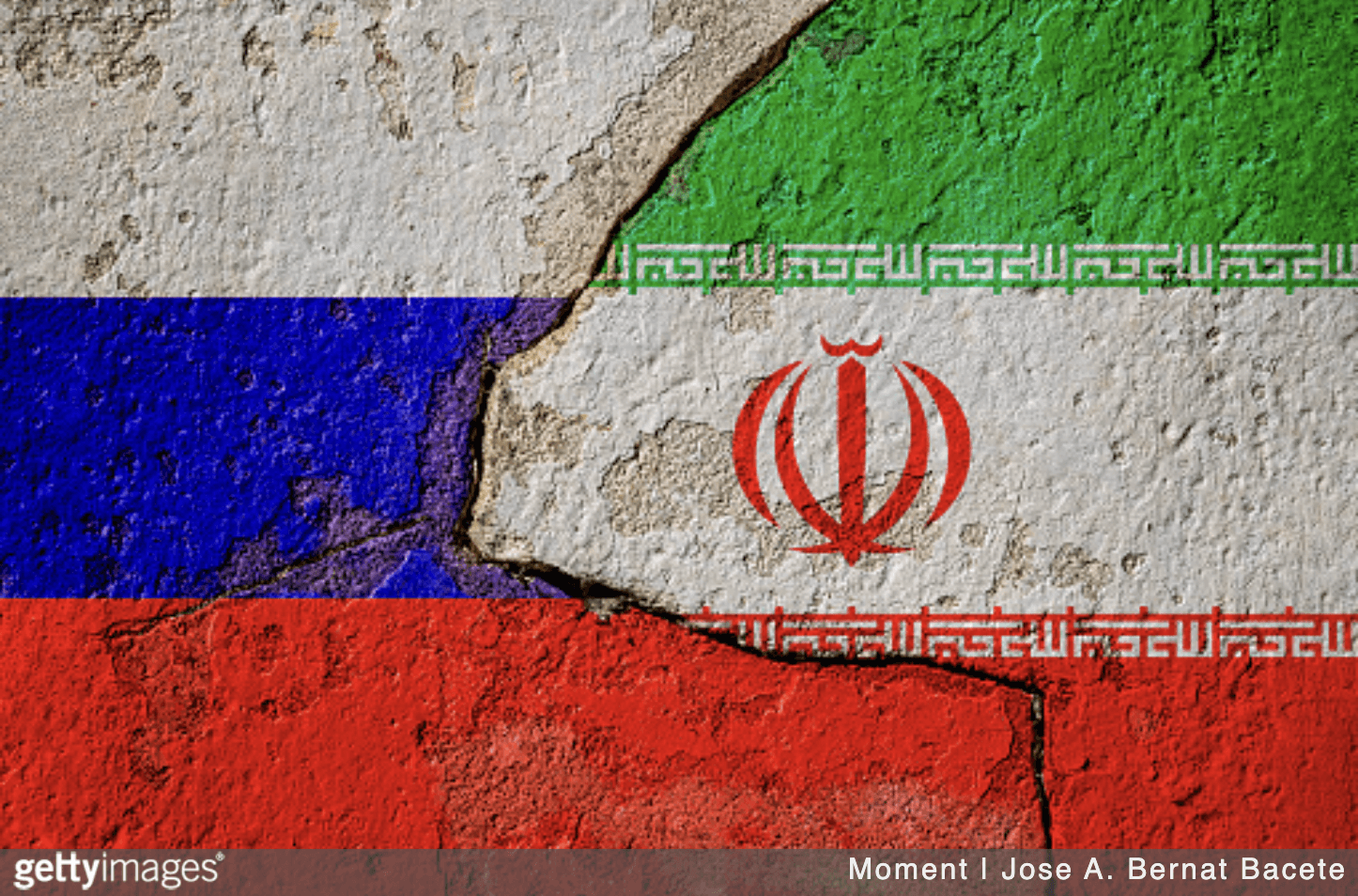
This I4AL Explainer seeks to explain why Russia might benefit from the continued Iranian aggression in the Strait of Hormuz. Russia can leverage strategic gains should the Iranian conflict continue or if Moscow mediates a resolution:
Oil prices are high and Russia can sell more. Strained oil markets pressure nations to purchase Russian oil at a premium.
Moscow can further sustain the wartime economy and military objectives in Ukraine.
Russia can gain influence in the new Iranian leadership. Reconciling the Iranian conflict can help Putin retain his regional foothold.
Russia’s Strategic Gains in Iran
The US and Israeli strikes in Iran have slowed oil exports from the Persian Gulf and increased the cost of oil. As price per barrel rises, the global market has turned to sources of oil outside of the Gulf, including Russia, which constitutes a strategic gain for Moscow. Sanctions on Russia, including on their oil industry, have been a drag on the Russian economy for more than a decade. Sanctions have dogged Russia since the passage of the Global Magnitsky Act in 2016 and continued in the wake of the full-scale invasion of Ukraine in 2022. However, the US Treasury Department Office of Foreign Asset Control issued a General License on March 12 ‘Authorizing the Delivery and Sale of Crude Oil and Petroleum Products of Russian Federation Origin Loaded on Vessels as of March 12, 2026.’ Allowing Russia to sell its oil at high prices on the global market may temporarily ease oil prices. It will also allow economic and strategic benefit to accrue to Moscow (Financial Times, 2026).
The Situation
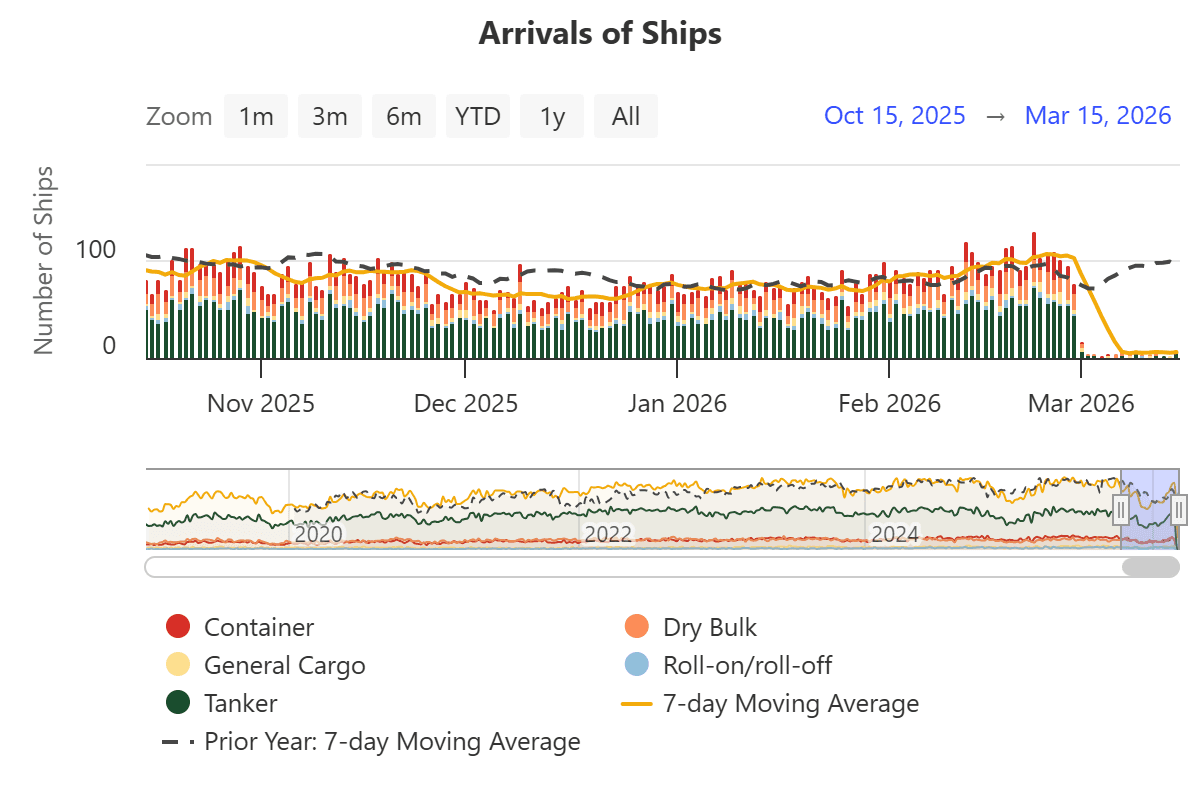
Since February 28th, 2026, the continued joint US and Israeli strikes have damaged or destroyed over 5,000 targets across Iran and 50+ Iranian ships (USCENTCOM, 2026). The strikes have targeted command centers, military equipment and facilities, naval assets, and offensive missile capabilities (US White House Press). The conflict has significantly reduced maritime traffic in the Strait of Hormuz, with Iran using low-cost Shahed drones to harass and attack commercial tankers attempting to cross. Additionally, Iran began targeting oil infrastructure in the Persian Gulf states, including Saudi Arabia’s Ras Tanura oil refinery (one of the largest in the world and particularly important for Saudi exports), UAE’s Fujairah oil-storage port, and several of Bahrain’s oil fields (Sabbagh, The Guardian, 2026)
Attribution: Iran Closing Strait of Hormuz Disrupting Global Oil Shipping Route, Vithun Khamsong via Getty Images
The Strait of Hormuz, a 35-60 mile (55-95 km) wide waterway between the Arabian Peninsula and Iran, handles 20% of the world’s oil shipments (Britannica). The inbound and outbound shipping lanes are only 2 miles or 3 km wide, making tanker routes predictable and susceptible to attacks (Strauss). It is not just Iranian oil that is blocked (as their oil has already been sanctioned by the West). Bahrain, Kuwait, the UAE, and Saudi Arabia have struggled to flex their shipping operations (Bloomberg, 2026). The Brent crude index topped $119 per barrel on March 8, though it has since fluctuated between $80 to $100 a barrel (Reuters, 2026). The volatility in oil prices will continue to drive global market insecurities, raising costs of not only oil, but agricultural and petroleum products (Kelly, Reuters, 2026) (Scotiabank, 2026).
Sources: UN Global Platform; IMF PortWatch (portwatch.imf.org).
The Restraints on the Russian Oil Economy
To understand the opportunity Moscow has in Iran, we must first look at the precarious position the Ukrainian and Venezuelan conflicts have put her in. Since Russia’s war on Ukraine, Russia has a mere 14% of global oil sales, a significant drop from 40% of the market share pre-2023. (CREA, 2025) (Worldbank, 2022). China, Türkiye, and India purchase ~75% of Russia’s crude oil exports (CREA, 2025); however, the US has since implemented sanctions on Russian oil buyers and continues to apply diplomatic pressures to persuade Türkiye and India to stop buying from Russia (Bose, Renshaw, Reuters, 2025). Global sanctions on oil as a response to the Ukraine war have hurt Russia’s economy over the past four years, which is facing severe stagnation of about >1% in GDP, according to estimates from the International Monetary Fund and the World Bank (Reuters, 2025). Russia’s 2026 federal budget depends on one-quarter of the country’s income to be from oil and gas exports, and therefore will run a deficit should it fail to sell oil at $59 per barrel or more (Reuters, 2026). With barrel prices almost double that today, Russia has a chance to capitalize off the unstable market to delay total economic stagnation (Reuters, 2026). Reports are coming out that Russia is already making millions on oil taxes (Financial Times, 2026). Under these circumstances, increased oil sales would sustain Russia’s defense economy and thereby, the war in Ukraine. However, these potential gains can only be perpetuated if Western countries are willing to halt sanctions on Russian oil companies.
Similarly, the US’s blockade around Venezuelan ports has reduced Russia’s profitability in the region, physically by restricting the tankers’ movements, and economically by forcing barrels to be sold at market prices (Kuteleva, E-International Relations, 2026). Russia has also lost access to selling Venezuela light crude oil, a crucial component for petroleum products that Venezuela does not have naturally, which is now 100% supplied by the United States (US State Department, 2026). Even Russia’s attempt to circumnavigate the US embargos and sanctions through using false flags (of the ship’s origin country) or ghost fleets (no country flags) to transport oil is threatened, as the US Navy and other western countries continue to seize these ships, thereby preventing these fleets from reaching their intended markets (Reilly, U.S. Naval Institute, 2025). Another foothold that the US has cut Russia out of is Cuba, a socialist island nation with strong political and economic ties with Russia (CEPA, 2026). The duo has agreed to several major investments in Cuban oil exploration, industrial plants, machinery, and educational and tourist programs, although China may be fulfilling this gap (Sherwood, Reuters, 2025). With Cuba in a humanitarian crisis, the US’s reported desire for change in both Cuba and Venezuela would further disrupt Russia’s influence in the Western Hemisphere (Kelemen, NPR, 2026).
Loosening the Restraints on Russian Oil
If Moscow can position herself strategically, she stands to benefit from the Iranian conflict by supplying market demands (Werz, Council on Foreign Relations, 2026). For example, without Western boycotts of Russian products, Russia can become one of the world’s largest exporters of wheat, fertilizer, and oil (FAO, 2026) (World Bank, 2022). The agricultural season and the oil industry have an established “dependence structure,” where fluctuations in global oil markets closely affect fertilizers and agricultural seasons (Mensi, Rehman, Gok, Gemici, Vo, 2025). As it stands right now, 20% of the oil market from the Gulf nations remains unable to participate in the global economy, as such, countries might begin buying Russian oil to satisfy short-term demands (Basquel, Atlantic Council, 2026).
The world at large has yet to capitulate to buying from Russia. Deliberations amongst European Union members, prompted by Hungary, are ongoing about purchasing oil from Russia, though the EU agreed to delay this decision as many countries still have untapped oil reserves (Beaumont, Jones, Connolly, Guardian, 2026). The one exception has been India. Typically, India receives 40% of its oil from the Middle East, but has recently purchased 6 million barrels of Russian oil since the Iranian conflict after the US issued General License 134, allowing countries a 30-day window to purchase Russian oil (Verma, Renshaw, Holland, Reuters, 2026). The White House’s plan to reduce India’s reliance on Russian oil imports has therefore been undermined and at least delayed until global markets adjust or return to normalcy. Even though India has been the only buyer, the pressure to buy Russian oil will increase every day the conflict in Hormuz continues. Increasingly, this will assuage Moscow’s budgetary concerns and simultaneously throws a wrench in the peace talks between Ukraine and Russia, yet another conflict Russia stands to win from the longer it goes on. Additionally, with Israeli strikes expanding to oil depots that have begun imploding across Tehran, (Habibiazad, BBC, 2026), it can be assumed that Russian oil is primed to fulfill Iran’s needs. The continued Hormuz blockade, therefore, is set for Russian gains economically and politically.
Attribution: The National Flag of the Russian Federation, Ayhan Altun via Getty Images
Putin the Mediator
In the case where the Strait of Hormuz traffic and global oil markets normalize, Russia still has a unique opportunity to retain regional influence. Moscow has long sought to lead mediation talks between the US, Israel, the Gulf States, and Iran. (Holland, Soldatkin, Reuters, 2025). Now more than ever, President Putin would need to remain a leader amidst the conflict to ensure a post-war Iran that is cooperative with Moscow. Retaining this political relationship that Russia has nurtured for a decade has several implications. Iran’s geographic access to the Indian Ocean is appealing for Russia as the shipping channels in the Baltic and Mediterranean seas remain complicated by tensions with western Europe (Nazar, Foreign Desk, 2022). Since China and India remain steadfast buyers of Russian oil exports, the Persian Gulf would provide significantly more secure, direct shipping lines (Raghunandan, CREA, 2025). Retaining these investments, trade agreements, and export prospects is crucial for Russia’s struggling wartime economy. Additionally, Iran and Russia have shared anti-Western sentiment and regional goals, particularly in Syria, Afghanistan, and Yemen, even so far as Iran blaming NATO for provoking Putin’s incursion into Ukraine (Wintour, Guardian, 2023). To retain this relationship, Putin must ensure the fall-out of the Iranian conflict includes not only a Russian-friendly government, but a stable one. While Washington seeks “unconditional surrender” in Iran, rhetoric has fallen short of demanding regime change thus far (Nerozzi, Washington Examiner, 2026). This indecision, particularly as many of Washington’s ideal successors to the Iranian Ayatollah were killed in the initial days of the strikes (New York Times, 2026), leaves plenty of space for Moscow’s influence in molding the new government and maintaining the country’s stability. Should Putin back an heir that satisfactorily straddles Western and Russian sympathies, he maintains a foothold in the region.
Source: Matteo Iacoviello, Bloomberg Finance LP, Scotia Wealth Management,
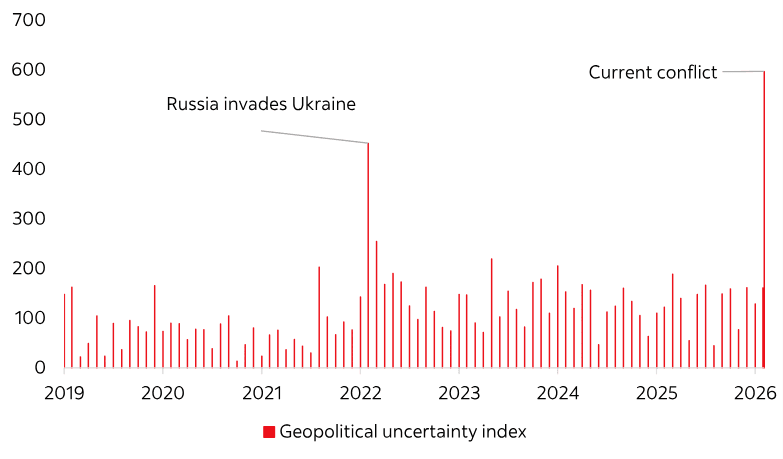
With the global oil supply in throes of uncertainty, Russia has an opportunity to gain a strategic edge whether by selling oil at higher-than-expected barrel prices, or by demonstrating continued regional leadership in the post-Iran conflict peace talks. Russia stands to gain millions in extra oil revenue due to these supply chain disruptions (Financial Times, 2026). However the situation unfolds, a new regional dynamic is ultimately forming in the Middle East.
Originally published by Kelli Tinerella for The GeoView.
References:
Bacete, Jose A. Bernat, 2025, Russian and Iranian flags painted on an old wall, divided by a deep crack. - stock photo, Getty Images. https://www.gettyimages.com/detail/photo/russian-and-iranian-flags-painted-on-an-old-wall-royalty-free-image/2231440917.
Senator Cardin, Benjamin L, 2016, Global Magnitsky Human Rights Accountability Act, United States Congress. https://www.congress.gov/bill/114th-congress/senate-bill/284/text
Office of Foreign Assets Control, 2026, Issuance of Russia-related General License, OFAC. https://ofac.treasury.gov/recent-actions/20260312_33
U.S. Central Command, 2026, U.S. Forces Launch Operation Epic Fury. USCENTCOM https://www.centcom.mil/MEDIA/PRESS-RELEASES/Press-Release-View/Article/4418396/us-forces-launch-operation-epic-fury/.
U.S. White House Press, 2026, America’s Unstoppable Momentum in Operation Epic Fury https://www.whitehouse.gov/articles/2026/03/americas-unstoppable-momentum-in-operation-epic-fury/.
Sabbagh, Dan, 2026, Iran has largely halted oil and gas exports through the Strait of Hormuz. The Guardian https://www.theguardian.com/world/2026/mar/03/iran-has-largely-halted-oil-and-gas-exports-through-strait-of-hormuz.
Khamsong, Vithun, 2026, Iran Closing Strait of Hormuz Disrupting Global Oil Shipping Route - stock photo, Getty Images. https://www.gettyimages.com/detail/photo/iran-closing-strait-of-hormuz-disrupting-global-oil-royalty-free-image/2265931961.
Britannica Editors, 2026, Strait of Hormuz, Encyclopedia Britannica. https://www.britannica.com/place/Strait-of-Hormuz.
Strauss Center for International Security and Law, 2026, Strait of Hormuz – About the Strait. https://www.strausscenter.org/strait-of-hormuz-about-the-strait/.
Prem, Prejula, 2026, Iran Supertanker Pushes Through Strait for China, Bloomberg. https://www.bloomberg.com/news/articles/2026-03-15/hormuz-tracker-iran-supertanker-pushes-through-strait-for-china.
Reuters, 2026, Goldman hikes average Brent oil forecast to over $100 a barrel for March. https://www.reuters.com/business/energy/goldman-hikes-average-brent-oil-forecast-over-100-barrel-march-2026-03-13/.
Kelly, Stephanie, 2026, Oil prices settle up 3% after renewed Iranian attacks on UAE, Reuters. https://www.reuters.com/business/energy/oil-gains-over-2-market-weighs-iran-war-supply-risks-2026-03-17/.
Scotia Wealth Management, 2026, Here’s what we’re thinking. https://enrichedthinking.scotiawealthmanagement.com/2026/03/06/heres-what-were-thinking-41/.
International Monetary Fund PortWatch, 2026, Port Monitor Strait of Hormuz, https://portwatch.imf.org/pages/cb5856222a5b4105adc6ee7e880a1730.
Raghunandan, Vaibhav, 2025 June 2025 — Monthly analysis of Russian fossil fuel exports and sanctions, Center for Research on Energy and Clean Air. https://energyandcleanair.org/june-2025-monthly-analysis-of-russian-fossil-fuel-exports-and-sanctions/.
World Bank Group, 2022, Global Economic Prospects, June 2022. https://thedocs.worldbank.org/en/doc/18ad707266f7740bced755498ae0307a-0350012022/original/Global-Economic-Prospects-June-2022.pdf.
Bose, Nandita and Jarrett Renshaw, 2025, Trump says Modi assured him India will stop buying Russian oil, Reuters. https://www.reuters.com/world/india/trump-says-modi-has-assured-him-india-will-not-buy-russian-oil-2025-10-15/.
Reuters, 2025, IMF downgrades Russia's 2025 GDP growth forecast to 0.6%. https://www.reuters.com/business/imf-downgrades-russias-2025-gdp-growth-forecast-06-2025-10-14/
https://www.reuters.com/business/energy/russias-march-oil-gas-revenues-expected-fall-52-year-on-year-2026-03-17/.
Reuters, 2026, Russia’s March oil and gas revenues expected to fall %52 year-on-year, Reuters. https://www.reuters.com/business/energy/russias-march-oil-gas-revenues-expected-fall-52-year-on-year-2026-03-17/
Reuters, 2026, Russia fails to capitalise on oil rally due to weather, drone attacks, according to data, sources. Reuters. https://www.reuters.com/business/energy/russia-fails-capitalise-oil-rally-due-weather-drone-attacks-according-data-2026-03-18/
Financial Times, 2026, Russia rakes in $150mn in a day in extra revenue from surging oil prices. Financial Times. https://www.ft.com/content/dd973148-b6a1-4096-97da-3090a058fe08
Kuteleva, Anya, 2026, Energy Security as Hierarchy: Venezuelan Oil in the US-China-Russia Triangle, E-International Relations. https://www.e-ir.info/2026/01/18/energy-security-as-hierarchy-venezuelan-oil-in-the-us-china-russia-triangle/.
U.S. State Department Press, 2026, Secretary of State Marco Rubio Before the Senate Committee on Foreign Relations on U.S. Policy Towards Venezuela. https://www.state.gov/releases/office-of-the-spokesperson/2026/01/secretary-of-state-marco-rubio-before-the-senate-committee-on-foreign-relations-on-u-s-policy-towards-venezuela/.
Reilly, Joseph, 2025, Shadow Fleets and Sea Denial, US Naval Institute. https://www.usni.org/magazines/proceedings/2025/august/shadow-fleets-and-sea-denial.
Chaguaceda, Armando and Cesar E. Santos, 2026, Cuba’s Woes Threaten the Kremlin’s Authoritarian International, Center for European Policy Analysis. https://cepa.org/article/cubas-woes-threaten-the-kremlins-authoritarian-international/.
Sherwood, Dave, 2025, China is quietly supplanting Russia as Cuba's main benefactor, Reuters. https://www.reuters.com/business/environment/china-is-quietly-supplanting-russia-cubas-main-benefactor-2025-06-30/.
Kelemen, Michele, 2026, Marco Rubio is pressing for change in Cuba. Will it work?
NPR. https://www.npr.org/2026/02/28/nx-s1-5727602/marco-rubio-is-pressing-for-change-in-cuba-will-it-work.
Werz, Michael, 2026, The Iran War’s Hidden Front: Food, Water, and Fertilizer, Council for Foreign Relations.
https://www.cfr.org/articles/the-iran-wars-hidden-front-food-water-and-fertilizer.
Food and Agriculture Organization of the United Nations, 2026, FAO presents key trends in global grain production and trade in Altai Krai (Russia’s breadbasket). https://www.fao.org/russian-federation/news/news-detail/fao-presents-key-trends-in-global-grain-production-and-trade-in-altai-krai-(russia-s-breadbasket/en.
World Bank Report, 2022, Commodity Markets Outlook: The Impact of the
War in Ukraine on Commodity Markets, April 2022. https://www.newsbreak.gr/wp-content/uploads/2022/04/CMO-April-2022.pdf.
Mensi, Walid, Mobeen Rehman, Remzi Gok, Eray Gemici, and Xuan Vinh Vo, 2025, Risk spillovers and diversification benefits between crude oil and agricultural commodity futures markets, Research in International Business and Finance.
https://doi.org/10.1016/j.ribaf.2024.102579.
Basquel, Lisa, 2026, How the Iran war could trigger a European energy crisis, Atlantic Council Dispatches. https://www.atlanticcouncil.org/dispatches/how-the-iran-war-could-trigger-a-european-energy-crisis.
Beaumont, Peter, Callum Jones, and Kate Connolly, 2026, Europe rebukes US for temporarily lifting sanctions on Russian oil, The Guardian.
https://www.theguardian.com/world/2026/mar/13/iran-war-oil-prices-russian-sanctions-lifted.
Verma, Nidhi, Jarrett Renshaw, and Steve Holland, 2026, Exclusive: Indian refiners buying prompt Russian oil as Iran war hits supplies, sources say, Reuters.
https://www.reuters.com/business/energy/indian-refiners-buying-prompt-russian-oil-iran-war-hits-supplies-sources-say-2026-03-05/.
Habibiazad,Ghoncheh, 2026, 'Night turned into day': Iranians tell of strikes on oil depots, BBC. https://www.bbc.com/news/articles/clygpxq41l3o.
Altun, Ayhan, 2023, The National Flag of the Russian Federation - stock photo, Getty Images. https://www.gettyimages.com/detail/photo/the-national-flag-of-the-russian-federation-royalty-free-image/1804566531.
Holland, Steve, and Vladimir Soldatkin, 2025, Russia seeks to serve as mediator between US and Iran, Reuters. https://www.reuters.com/world/russia-seeks-serve-mediator-between-us-iran-2025-03-04/.
Nazar, Elliot, 2022, Iran and Russia Building New Trade Route to Bypass International Sanctions, The Foreign Desk. https://foreigndesknews.com/top-story/iran-and-russia-building-new-trade-route-to-bypass-international-sanctions/.
Wintour, Patrick, 2023, Iran accuses US of stoking Ukraine war in UN speech, sparking Israel walkout, The Guardian.
https://www.theguardian.com/world/2023/sep/20/iran-un-speech-ebrahim-raisi-accuses-us-of-stoking-ukraine-war.
Nerozzi, Timothy and Mike Brest, 2026, Trump’s evolving stance on Iran ‘unconditional surrender’, Washington Examiner. https://www.washingtonexaminer.com/news/world/4488508/trump-evolving-stance-iran-unconditional-surrender/.
The New York Times, 2026, Iranians Viewed by U.S. as Potential Leaders Died in Strikes, Trump Says. https://www.nytimes.com/2026/03/03/world/middleeast/iranian-leaders-trum.html.
Tinerella, Kelli, 2026, The Hormuz Paradox: Why the Hunt for Iran is Saving the Kremlin, The GeoView Intelligence. https://thegeoview.substack.com/p/the-hormuz-paradox-why-the-hunt-for-iran-is-saving-the-kremlin?triedRedirect=true.